Month: September 2015

CHANGING FOR ORGANISATIONAL GROWTH

Change is an inevitable aspect of life. It is therefore necessary to undertake successful change efforts to foster growth and development. Successful change efforts are dependent on the effectiveness of the change model or formula utilized in managing the transition.

THE SCE FORMULA

                                                  SCE = D x V x Fs x B

Where:

SCE = Successful Change Effort
D.      = Dissatisfaction with the current state
V       = Vision for a desired Future
Fs     = First small steps to implement change
B.      = Belief in the desired future state

The working principle: No value < or = 0.

DISSATISFACTION: This underlines the amount of displeasure in the current state of the organisation. It calls for a reality check to identify the true worth of the organisation efforts a
against its performance. For there to be change, there need to be enough dissatisfaction to warrant the change. In an Organisational change process, it is important to uncover dissatisfying issues through data collection to give the need for change the needed attention.
VISION: Having identified dissatisfaction with a current state, a SMART vision of the desired future state should be carved into the minds of the people to perceive a more desirable future. This serves as a motivator to see the change effort though. It stands as a trophy for a successful change effort.
FIRST SMALL STEP: Just as the 1000 mile journey shall always begin with a first step, so does it follow in that, every successful change effort shall always begin with a first small step. This step may vary between persons, organisations and Visionary stand points. However, the emphasis lies in the ability to make a strategic step towards a desired goal or vision.
BELIEF: This may be described as the fuel kindling the fires of each strategic step. It is what keeps the vision alive and worth the effort. Every change effort requires a deep rooted belief in it success, outcomes and benefits.

                                                         THE ROLE OF THE CHANGE AGENT
The organisational Development (OD) Consultant otherwise referred to as the change agent has an exponential role to play in success of the change effort. While acting as a facilitator, the amount of clarity and trust may depend on the unique ability of the consultant to apply a proven formula of sustainable change.
The change agent shall be responsible without limitation to:
Bring to the fore, a true reflection of the current state through data collection and feedback.
This is intended to serve as a mirror for the organisation to see its shortfalls as perceived by the organisation itself thereby unearthing enough dissatisfaction to warrant a change effort.
Empower the organisation to see a better future through the eyes of the organisation itself thereby creating a vision a transcending beyond the current state of the organisation. The Consultant may be required herein to provide enough direction to create a vision which is Specific, Measurable, Achievable, Relevant and Time-Bound.
Engage the organisation in strategic planning. This is deemed as a tool that transforms visions and ideas into realities. It is the process that will stipulate the various steps in achieving the  the vision for a better future. The OD consultant may be required to facilitate a strategic plan to develop the vision into actionable steps.
Finally comes the belief factor. A change effort will not succeed unless the client organisation believes its ability and capability to change and sustain a desired future. This is inevitably the duty of the change agent to guide the organisation to trust in the process as well as themselves.

For more on Organisational Development Contact :
“The  Organisational Development Professionals”St VItus OD Consult

ARE YOU A WANTREPRENEUR OR AN ENTREPRENEUR?

image

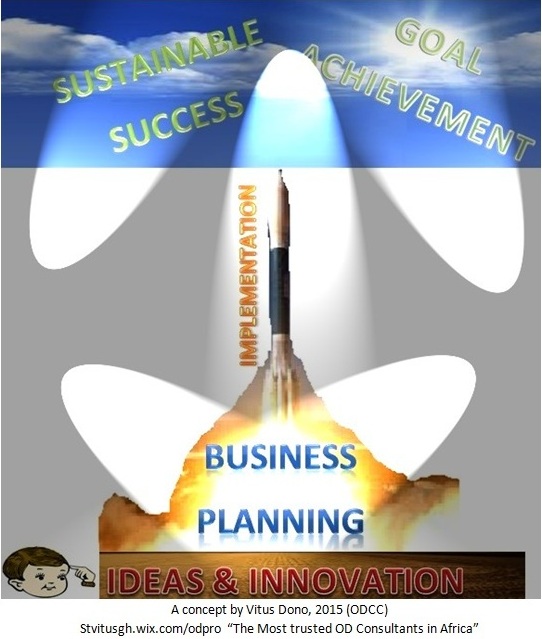
The misconception that everyone  who conceives or starts a great Idea is an entrepreneur has misled potentially successful Corporations to crumble and fold up within the first five years of the business’ life. True entrepreneurs know as a fact that establishing a self-sustaining Idea goes beyond the conception and inception of a business. Leaders of the Business world know all too well that the unique key to the successful establishment, sustainability and growth of every business lies in the skill to develop a systematic and fail-proof Business or Strategic plan. Sadly, many persons with great ideas tend to delude themselves into believing they have everything planned out, and are often too enthused in the glow of their ideas to realize the need to follow the science of Strategic or Business planning.
While a comprehensive business plan presents the entrepreneur with several funding opportunities, the process of developing the plan is of priceless value to the entrepreneur. The process of Business planning using the unparalleled Organisational Development(OD) approach serves as a mirror which transforms the feasibility and viability of the business into a reality. In practice, a good business plan is the lifeline of every successful business, and has always been the growth specimen of successful companies.
It is herein expedient to reason out the importance of experiential training using proven OD models and strategies to equip the youth of our continent in the preparation of apt business plans. The unique OD approach allows entrepreneurs to polish up their Ideas into SMART business plans while building commitment and direction for their business. Pragmatic experience in business and strategic planning as applied in OD, is what African entrepreneurs and  “wantrepreneurs” need  to enable sustainable development.

For more on Business planning, contact St VItus OD Consult


THE TRANSFORMATION OF AFRICA LIES IN ORGANISATIONAL DEVELOPMENT

The African continent is saddled with a myopic and eccentric politicking which has for ages, tied Africa to a pathetic state of under development, destruction and disaster. It is indeed ironic to find Africans amongst the top richest individuals in the world while the continent stills rates as the poorest. It is no secret that Africa is endowed with most of the world’s most valuable minerals and natural reserves. Yet, the fact of mismanagement of our assets hits us hard in the face each time Africa is mentioned. While we cannot dispute the unlimited educational strive of our leaders, we may need to question the application of what they learn in the development of this continent. Africa will not hesitate to boast of learned Professors and Doctors in several disciplines. In the light of Organisational Development (OD), the more critical aspect of our development lies not only in the content but more critically in the process. African leaders need to divert from the stereotyped  dogmatic principles of development and embrace the more pragmatic participatory approach to development practiced in OD.
Organisational Development (OD) involves facilitating an organisation’s ability to self-reflect, self regulate, and take control of its  own processes of improvement and learning (Kaplan, 1966) with a view to effectively achieving its purpose for existence (Kumawu and Kraus, 2007)
OD is a systematically planned effort to transform an Organisation into higher, healthier and self sustaining performance through critical capacity assessment and planned interventions.(Personal).
OD is unique in its approach to development due to the its application of the Action Research Model in all change efforts. One unsurpassed strength of the OD approach is the use of data gathering and analysis to reflect the true state of the organisation prior to action planning. More often than not, African leaders are prone to unclassified assumptions prompting them into assumed solutions which often end up temporarily shadowing the real problems and hindrances to development. It is an established fact that most surfacing problems are often symptoms of an underlying defect in a system. African organisations will need as a lifeline, to embrace the tested and proven processes of OD if there is any hope for the transformation of the African continent.
The goal of OD is to improve organisational effectiveness as defined by the organisation itself and it is only when African Leaders have been able to embed OD into various political and governmental organisations across the sub-region , can we see true transformation of the African Continent.

Read More on Organization Development at www.vitusodconsult.com 

References
Kaplan, Allan (1996) The Development Practitioner’s Handbook, London Pluto Press.
Noble Kumawu and William A. Kraus: Global Organisation Development, A Model for Africa and the World OCIC. Accra, Ghana. 2007.


EMOTIONALLY INTELLIGENT LEADERS OF AFRICA

Emotional Intelligence is the ability to acquire and apply knowledge and skill by harnessing and managing your emotions while managing relations with others based on a conscious awareness of their emotions. It may be defined as “a form of social intelligence that involves the ability to monitor one’s and others’ feelings and emotions to discriminate among them and use this information to guide one’s thinking and action( Salovey & Mayer,1990)

According to Daniel Goleman, Self-awareness, self-regulation and self-motivation are crucial components of emotional and social intelligence. The most accomplished of sub-saharan Africa have constantly exhibited remarkable emotional intelligence. Sensing what people are feeling, being able to take their perspective and build rapport is indeed emotional intelligence.

Evidence of high emotional quotients is seen in the transformational leadership of accomplished African Leaders. One prominent African leader with explicit and countless display of emotional intelligence is Sir Seretse Khama, the first president of Botswana in 1966.

Born into one of the powerful families of Botswana and with a controversial inter-racial marriage, Sir Karma was pushed into complications and controversies which warranted adept applications of emotional smartness to succeed in his life career.

Firstly, Seretse Khama in the light of the apparent racism in the neighbouring states of South Africa and beyond returned to Botswana with his foreign wife Ruth William. It indeed requires a great deal of self-awareness to be able to take such bold steps. Despite the troubles of rejection, racism and exile, Seretse Khama still managed to win the hearts of his people because he exhibited true emotional intelligence in managing himself utilizing the emotional perspectives of the people of Botswana to his advantage.

Secondly, “In 1956, Seretse and Ruth Khama were allowed to return to Bechuanaland as private citizens, after he had renounced the tribal throne.”(Seretse Khama, Wikipedia). Emotional smartness requires a conscious awareness of your situation and the forces and emotions around you to be able to make right choices. This was clearly exhibited is Khama’s return as private citizen and the renouncing of the tribal throne. He was smart enough to realize that this was the only way to return peacefully and still maintain credibility amongst his people.

Thirdly, “In 1961, however, Khama leaped back onto the political scene by founding the nationalist Bechuanaland Democratic Party. His exile gave him an increased credibility with an independence-minded electorate.( Seretse Khama, Wikipedia). Knowing when to take specific action by being conscious of the societal emotions is good application of emotional intelligence. Seretse Khama knew this and pitched the right time when he was aware of the credibility he had earned amongst his people to launch his political party

At the time of its independence, Botswana was among the world’s poorest countries, even poorer than most other African countries. Khama set out on a vigorous economic programme intended to transform it into an export-based economy, built around beef, copper and diamonds. (Guest, 2004). Khama upon assuming presidency had to utilize a quantum of EQ to be able to decisively plunge the country in an export based economy. By his immense social awareness, he identified the strength in exporting beef, copper and diamonds and quickly set out a mission based on his social realization.

According to Richard dale, a week after independence, Sir Seretse Khama announced before the National Assembly his government’s policy to insure that Botswana would not become a base of operations for attacking any neighbour.(Dale 1995). In the light of foreign policy, Khama’s emotional intelligence guided his decisions in exercising careful politics not to allow militant groups to operate from within Botswana.

Another clear evidence of emotional intelligence is evidenced by the number of persons who attended the burial of Seretse Khama in 1980. Forty thousand people paid their respects while his body lay in state in Gaborone .(Tlou et al,1995). This signifies that, Khama had prior to and in his term of office empathized and aligned himself with the people to a great extent. This is obviously a clear demonstration of emotional intelligence

Another commendable display of emotional intelligence is how he managed to “uphold liberal democracy and non-racialism in the midst of a region embroiled in civil war, racial enmity and corruption”. Khama exhibited decisive evidence of social awareness and self-management in taking key decisions for the benefit of his people and the country as a whole. In his last years, he played an important role in southern African politics when he negotiated the future of Zimbabwe and South West African Namibia and developed a vision of a southern Africa post-colonialism and post–apartheid, seen to be a key part in the development of the Southern African Development Community that has since been founded.

In conclusion, Seretse Khama in his lifetime demonstrated clear manifests of emotional intelligence. He constantly proved in his actions and decisions that he was fully aware of himself and the society in which lived and he managed himself and relations to the absolute benefit of the country. The emotional smartness and high emotional quotient of Seretse Khama is embedded is his view on history, quoted from a speech at the University of Botswana, Lesotho and Swaziland in 1970:

“in a very positive way, to despise ourselves and our ways of life. We were made to believe that we had no past to speak of, no history to boast of. The past, so far as we were concerned, was just a blank and nothing more. Only the present mattered and we had very little control over it. It seemed we were in for a definite period of foreign tutelage, without any hope of our ever again becoming our own masters. The end result of all this was that our self-pride and our self-confidence were badly undermined.


Visit St VItus OD Consult to read more intriguing concepts to organizational and personal development

References

Salovey, P. & Mayer, J. D. (1990). Emotional intelligence.

Robert Guest (2004). The Shackled Continent.

Tlou, Thomas; Parsons, Neil; Henderson, Willie (1995). Seretse Khama, 1921–1980

Http//www.wikipedia.com/ Sir Seretse Khama.html

Dale, Richard. Botswana’s Search for Autonomy in Southern Africa. Westport: Greenwood Press, 1995: 50